Seventeen debts.
Every one of them a person, except the last.
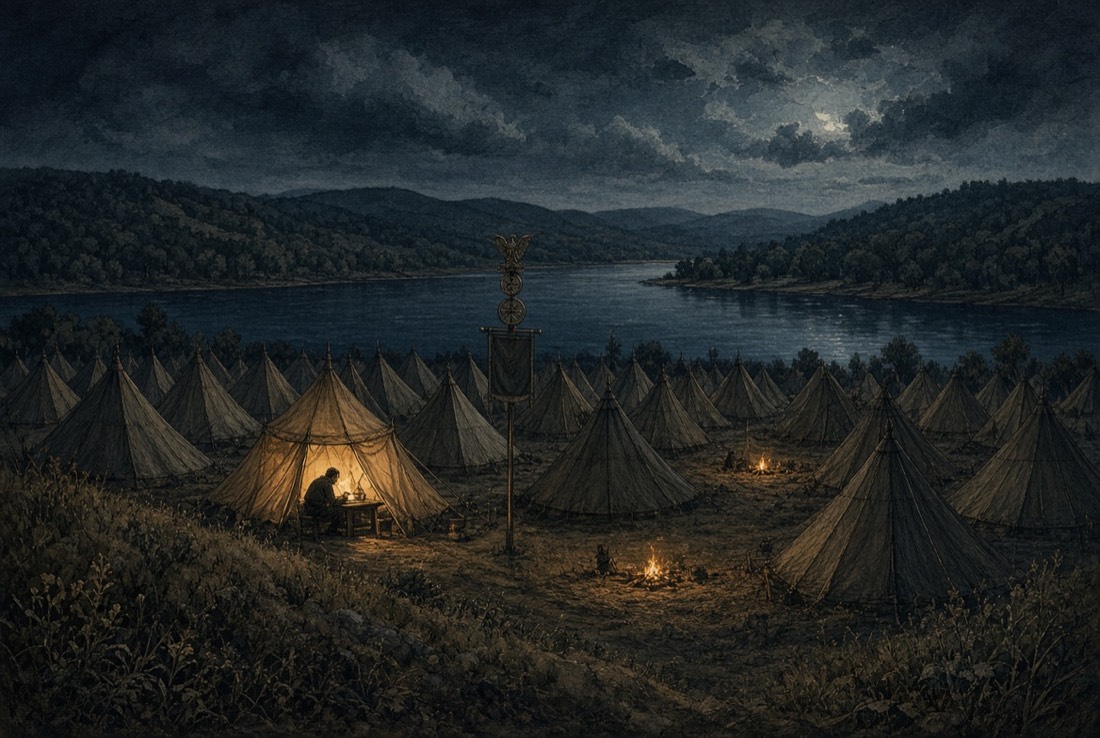
Before anything else, the emperor writes down what he owes. Seventeen entries, each one a person and the thing he got from them. He wrote it on campaign, among the Quadi on the river Granua, for nobody but himself.
Seventeen debts.
Every one of them a person, except the last.
I. From my grandfather Verus I learned good morals and the government of my temper.
Marcus Annius Verus: three times consul and Prefect of the City. The family had been settled in Spain for generations before it came to Rome. Marcus was brought up in his house after his own father died.
Prefect of the City, from a family long settled in Spain.
He brought Marcus up after his father died.
The phrase Long renders "the government of my temper" is about the ruling faculty, the part of a person that judges and assents. Anger is the passion Marcus returns to more than any other; much of Book XI is an argument with himself about it.
Anger is the subject he returns to most. Book XI is largely an argument with himself about it.
II. From the reputation and remembrance of my father, modesty and a manly character.
Marcus Annius Verus the younger, praetor. He died when Marcus was about three. Beyond the office and the death, almost nothing is recorded.
No place is recorded for his father.
Dead before Marcus was four.
His father died when Marcus was about three. He is not thanking a memory here — he is thanking a reputation, assembled out of what other people told him about a man he never knew.
III. From my mother, piety and beneficence, and abstinence, not only from evil deeds, but even from evil thoughts; and further, simplicity in my way of living, far removed from the habits of the rich.
Domitia Lucilla, heiress to a brickworks outside Rome whose makers’ stamps are still turned up today. Her house stood on the Caelian Hill. Marcus was with her when she died.
Her house stood on the Caelian Hill in Rome.
She outlived his accession to Caesar; the year of her death is argued over.
Domitia Lucilla was extremely rich; she owned brickworks outside Rome whose stamps survive. "Far removed from the habits of the rich" is therefore a claim about how she lived, not about what she had.
IV. From my great-grandfather, not to have frequented public schools, and to have had good teachers at home, and to know that on such things a man should spend liberally.
Catilius Severus: governor of Syria, proconsul of Asia, twice consul, Prefect of the City. Marcus was very nearly named after him instead.
Governor of Syria, proconsul of Asia, then Prefect of the City.
Of his boyhood.
Boys of his rank went out to a grammaticus. Keeping teachers at home was the more expensive course, which is the point of the entry: that money is worth spending on this and on little else.
V. From my governor, to be neither of the green nor of the blue party at the games in the Circus, nor a partisan either of the Parmularius or the Scutarius at the gladiators' fights; from him too I learned endurance of labor, and to want little, and to work with my own hands, and not to meddle with other people's affairs, and not to be ready to listen to slander.
His paedagogus — the household slave or freedman who walked a boy to his lessons and answered for his conduct. Marcus never gives his name, here or anywhere else.
His governor is not named, and no place is recorded.
The Greens and Blues were chariot factions, and faction was how ordinary Romans did politics — it could and did turn into riot. Refusing to belong to either is not indifference; it is a position.
VI. From Diognetus, not to busy myself about trifling things, and not to give credit to what was said by miracle-workers and jugglers about incantations and the driving away of daemons and such things; and not to breed quails for fighting, nor to give myself up passionately to such things; and to endure freedom of speech; and to have become intimate with philosophy; and to have been a hearer, first of Bacchius, then of Tandasis and Marcianus; and to have written dialogues in my youth; and to have desired a plank bed and skin, and whatever else of the kind belongs to the Grecian discipline.
His painting master. That he taught Marcus to paint, and turned him toward philosophy, is the whole of what survives about him.
Nothing is recorded of Diognetus but that he taught him painting.
The boy who took up philosophy at about twelve.
Quail-fighting was a gambling sport. Notice the company the entry keeps it in: miracle-workers, exorcists, incantations. They are all the same failure — letting yourself be taken in.
VII. From Rusticus I received the impression that my character required improvement and discipline; and from him I learned not to be led astray to sophistic emulation, nor to writing on speculative matters, nor to delivering little hortatory orations, nor to showing myself off as a man who practises much discipline, or does benevolent acts in order to make a display; and to abstain from rhetoric, and poetry, and fine writing; and not to walk about in the house in my outdoor dress, nor to do other things of the kind; and to write my letters with simplicity, like the letter which Rusticus wrote from Sinuessa to my mother; and with respect to those who have offended me by words, or done me wrong, to be easily disposed to be pacified and reconciled, as soon as they have shown a readiness to be reconciled; and to read carefully, and not to be satisfied with a superficial understanding of a book; nor hastily to give my assent to those who talk overmuch; and I am indebted to him for being acquainted with the discourses of Epictetus, which he communicated to me out of his own collection.
Quintus Junius Rusticus, Stoic, twice consul and Prefect of the City. As prefect he later presided over the trial and execution of Justin Martyr.
Prefect of the City.
The years in which Marcus became a Stoic.
It was Rusticus who lent him Epictetus from his own library. Nearly everything Stoic in the Meditations arrives through that loan, which makes this the most consequential entry in the book.
The Epictetus that Rusticus lent him is quoted more than any other source — most heavily in Books XI and XII.
VIII. From Apollonius I learned freedom of will and undeviating steadiness of purpose; and to look to nothing else, not even for a moment, except to reason; and to be always the same, in sharp pains, on the occasion of the loss of a child, and in long illness; and to see clearly in a living example that the same man can be both most resolute and yielding, and not peevish in giving his instruction; and to have had before my eyes a man who clearly considered his experience and his skill in expounding philosophical principles as the smallest of his merits; and from him I learned how to receive from friends what are esteemed favors, without being either humbled by them or letting them pass unnoticed.
A Stoic brought from the east at considerable expense to teach the heir. Called “of Chalcedon”; others say Chalcis, and Cassius Dio says Nicomedia.
Called “of Chalcedon” — though some say Chalcis, and Cassius Dio says Nicomedia.
The Stoic claim is that the wise man is the same in every circumstance. Marcus buried most of his children; when he writes "the loss of a child" he is naming something he needed this doctrine for.
Book IV returns to it as the headland: “Be like the promontory against which the waves continually break.”
IX. From Sextus, a benevolent disposition, and the example of a family governed in a fatherly manner, and the idea of living conformably to nature; and gravity without affectation, and to look carefully after the interests of friends, and to tolerate ignorant persons, and those who form opinions without consideration:+ he had the power of readily accommodating himself to all, so that intercourse with him was more agreeable than any flattery; and at the same time he was most highly venerated by those who associated with him: and he had the faculty both of discovery and ordering, in an intelligent and methodical way, the principles necessary for life; and he never showed anger or any other passion, but was entirely free from passion, and also most affectionate; and he could express approbation without noisy display, and he possessed much knowledge without ostentation.
Sextus of Chaeronea in Boeotia, of Plutarch’s family — nephew or grandson, the sources differ. He taught Lucius Verus as well.
Sextus of Chaeronea in Boeotia, a nephew of Plutarch.
"To live conformably to nature" is the central Stoic formula — living in agreement with how things actually are, rather than how one would prefer them. It recurs throughout the later books.
Living conformably to nature comes back in Books IV and XII.
X. From Alexander the grammarian, to refrain from fault-finding, and not in a reproachful way to chide those who uttered any barbarous or solecistic or strange-sounding expression; but dexterously to introduce the very expression which ought to have been used, and in the way of answer or giving confirmation, or joining in an inquiry about the thing itself, not about the word, or by some other fit suggestion.
Alexander of Cotiaeum in Phrygia, the most admired Homeric scholar of the age. He taught Aelius Aristides too, and lived in the Palace at Rome.
Alexander of Cotiaeum in Phrygia, who lived in the Palace at Rome.
His Greek grammar, in boyhood and after.
The lesson is about correcting someone without the correction being about you. Supply the right word and move on; do not take the opportunity to be seen being right.
XI. From Fronto I learned to observe what envy and duplicity and hypocrisy are in a tyrant, and that generally those among us who are called Patricians are rather deficient in paternal affection.
Marcus Cornelius Fronto of Cirta, the leading Latin orator of his day. Their letters survive and are warm; he spent years trying to stop Marcus abandoning rhetoric for philosophy, and failed.
An orator from Cirta in Africa, who led the bar at Rome.
Tutor, then correspondent, until Fronto died.
Fronto was his rhetoric master and their letters survive, full of affection. What Marcus records from him is not eloquence but a warning about what power does to a man.
XII. From Alexander the Platonic, not frequently nor without necessity to say to any one, or to write in a letter, that I have no leisure; nor continually to excuse the neglect of duties required by our relation to those with whom we live, by alleging urgent occupations.
A rhetorician of Seleucia, made Marcus’s Greek secretary while headquarters were in Pannonia.
A rhetorician from Seleucia, appointed while headquarters were in Pannonia.
Appointed during this very campaign.
"I have no leisure" as a way of getting out of an obligation. Seneca makes the same attack in On the Shortness of Life: people guard their money and squander the one thing they cannot get back.
Book IV puts it as an instruction: do few things, if you would have tranquillity.
XIII. From Catulus not to be indifferent when a friend finds fault, even if he should find fault without reason, but to try to restore him to his usual disposition; and to be ready to speak well of teachers, as it is reported of Domitius and Athenodotus; and to love my children truly.
Cinna Catulus, a Stoic. The commentary’s whole note on him is “of whom nothing more is known”.
Cinna Catulus, “of whom nothing more is known”.
Taking correction from a friend without resentment is a recurring Stoic test, because the friend is the only person who will tell you. The second half of the entry — loving children truly — sits oddly beside it, and he left both.
XIV. From my brother Severus, to love my kin, and to love truth, and to love justice; and through him I learned to know Thrasea, Helvidius, Cato, Dion, Brutus; and from him I received the idea of a polity in which there is the same law for all, a polity administered with regard to equal rights and equal freedom of speech, and the idea of a kingly government which respects most of all the freedom of the governed; I learned from him also + consistency and undeviating steadiness in my regard for philosophy; and a disposition to do good, and to give to others readily, and to cherish good hopes, and to believe that I am loved by my friends; and in him I observed no concealment of his opinions with respect to those whom he condemned, and that his friends had no need to conjecture what he wished or did not wish, but it was quite plain.
Probably Claudius Severus, a Peripatetic, whose son married one of Marcus’s daughters. Long renders the Greek as “my brother”; whether that is what it means is argued over, and no birthplace is recorded.
No place is recorded for Severus.
"A kingly government which respects most of all the freedom of the governed" — written by a man with absolute power, about the kind of rule he intended to exercise. Judge it against the reign.
XV. From Maximus I learned self-government, and not to be led aside by anything; and cheerfulness in all circumstances, as well as in illness; and a just admixture in the moral character of sweetness and dignity, and to do what was set before me without complaining. I observed that everybody believed that he thought as he spoke, and that in all that he did he never had any bad intention; and he never showed amazement and surprise, and was never in a hurry, and never put off doing a thing, nor was perplexed nor dejected, nor did he ever laugh to disguise his vexation, nor, on the other hand, was he ever passionate or suspicious. He was accustomed to do acts of beneficence, and was ready to forgive, and was free from all falsehood; and he presented the appearance of a man who could not be diverted from right, rather than of a man who had been improved. I observed, too, that no man could ever think that he was despised by Maximus, or ever venture to think himself a better man. He had also the art of being humorous in an agreeable way.+
Claudius Maximus, Stoic and consul. He may be the proconsul of Africa before whom Apuleius defended himself against a charge of magic — may be; it is not settled.
He may be the proconsul of Africa before whom Apuleius spoke. It is not certain.
Consistency is the Stoic measure of character: the same man in public and alone, in health and in illness. "No one could think that he was lying" is the highest thing Marcus says about anybody here.
XVI.
Emperor from 138 to 161, who adopted Marcus at Hadrian’s direction. His reign is the least eventful of any emperor’s, which in Rome is close to the highest thing that can be said.
His country seats were at Lorium and Lanuvium, near Rome.
Adopted at seventeen; emperor at forty when Antoninus died.
The longest entry in the book, and the model Marcus measures himself against for the rest of it. In Book VI he reduces it to one instruction: in everything, act as a disciple of Antoninus.
Book VI reduces this whole entry to one line: do everything as a disciple of Antoninus.
XVII.
No person: the book closes by turning outward, and the list of what he owes the gods runs almost as long as the list for his father.
He thanks the gods, and names no place at all.
The whole of it.
The only entry addressed outward rather than to himself. Gratitude practised as a discipline — naming what you were given, so that you cannot mistake it for something you achieved.
Text: George Long, 1862, public domain, from Project Gutenberg, set unaltered — footnote marks removed, and Long's bracketed words kept, because the Greek omits the verb. XVI and XVII are lists because that is how they are punctuated: twenty-four clauses and nineteen, each a separate debt. Places follow the Wikisource commentary on Book One; where it records none — his father, his governor, Diognetus, Catulus, Severus — the map says so rather than guessing.